> For the complete documentation index, see [llms.txt](https://wiki.mksdtech.com/llms.txt). Markdown versions of documentation pages are available by appending `.md` to page URLs; this page is available as [Markdown](https://wiki.mksdtech.com/beam/beam-for-revit/ray.md).
# RAY
Export Autodesk® Revit™ geometry and data to Rhino®
**RAY** exports Revit geometry, materials, parameters, levels and coordinates to files that [RAY for Rhino](/beam/beam-for-rhinoceros/ray.md) imports. Elements arrive on Rhino layers named after their Revit category, which you can change with a [layer mapping](/beam/beam-for-revit/ray/layer-mapping.md).
RAY runs Rhino inside Revit, so Rhino 7 or 8 must be installed. See [Rhino inside Revit](/beam/beam-for-revit/using-beam-for-revit.md#rhino-inside-revit).
## Export
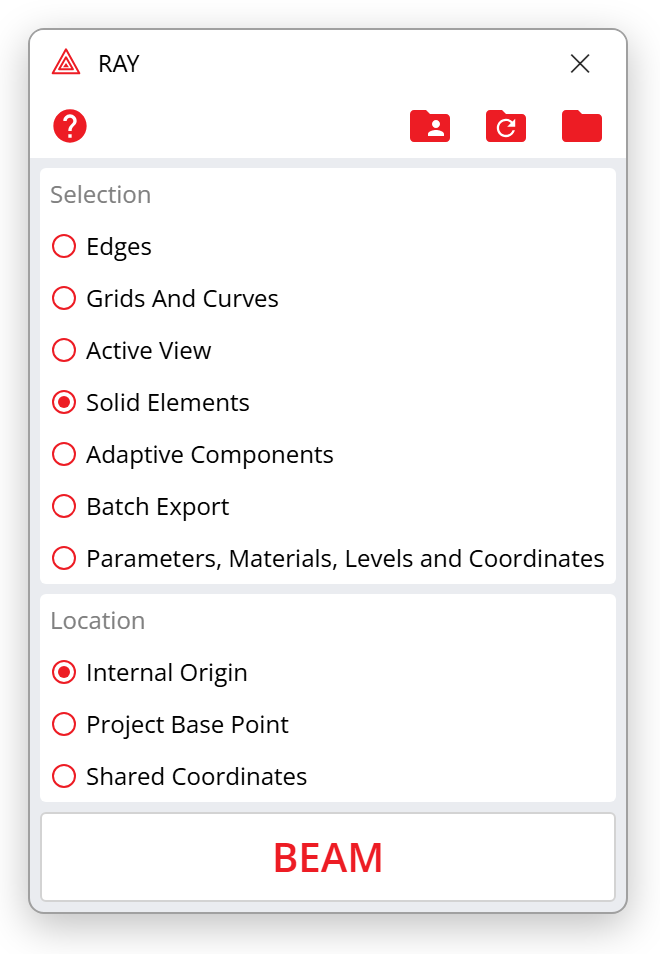
Click **RAY** on the [BEAM tab](/beam/beam-for-revit/using-beam-for-revit.md).
### Selection
| Option | What it exports |
| ------------------------------------------------- | ------------------------------------------------------------------------------------------ |
| **Edges** | Edges you pick |
| **Grids And Curves** | Grids and model or detail curves you pick |
| **Active View** | Everything visible in the active view. The view must be a 3D view. |
| **Solid Elements** | Elements you pick, as solids and meshes. This is the default. |
| **Adaptive Components** | Adaptive components you pick, as polylines and points with their **Mark** |
| **Batch Export** | Several Revit files at once. See [Batch Export](/beam/beam-for-revit/ray/batch-export.md). |
| **Parameters, Materials, Levels and Coordinates** | Project data, without geometry |
If you selected elements before clicking **RAY**, the **Selection** options are hidden and RAY exports your selection.
**Adaptive Components** and **Parameters, Materials, Levels and Coordinates** are not available in the Family Editor.
### Location
Where the Revit coordinates land in Rhino: **Internal Origin**, **Project Base Point** or **Shared Coordinates**. For shared coordinates, pick the location.
### Pick and save
1. Click **BEAM**.
2. Select the elements in Revit and click **Finish** on the options bar. Skip this for **Active View**.
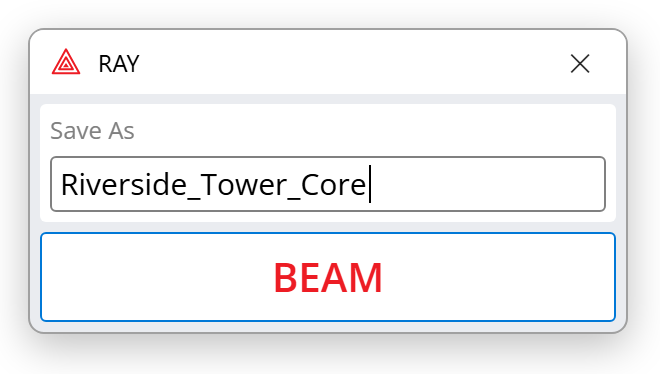
3. Name the export in **Save As**. Use letters, numbers, spaces, `_` and `-`. Leave it empty for a random code.
4. Click **BEAM**.
RAY saves a `.3dm` file in the [.beam directory](/beam/beam-for-rhinoceros/beam-directory.md). Import it in Rhino with [RAY](/beam/beam-for-rhinoceros/ray.md).
## What you get in Rhino
* Elements made of several parts are grouped.
* Revit materials become Rhino materials.
* Each object stores its Revit **Family : Type** and subcategory.
* Adaptive components keep their **Mark**, so you can edit them in Rhino and update them with [URSA](/beam/beam-for-revit/ursa.md).
## Export parameters, materials, levels and coordinates
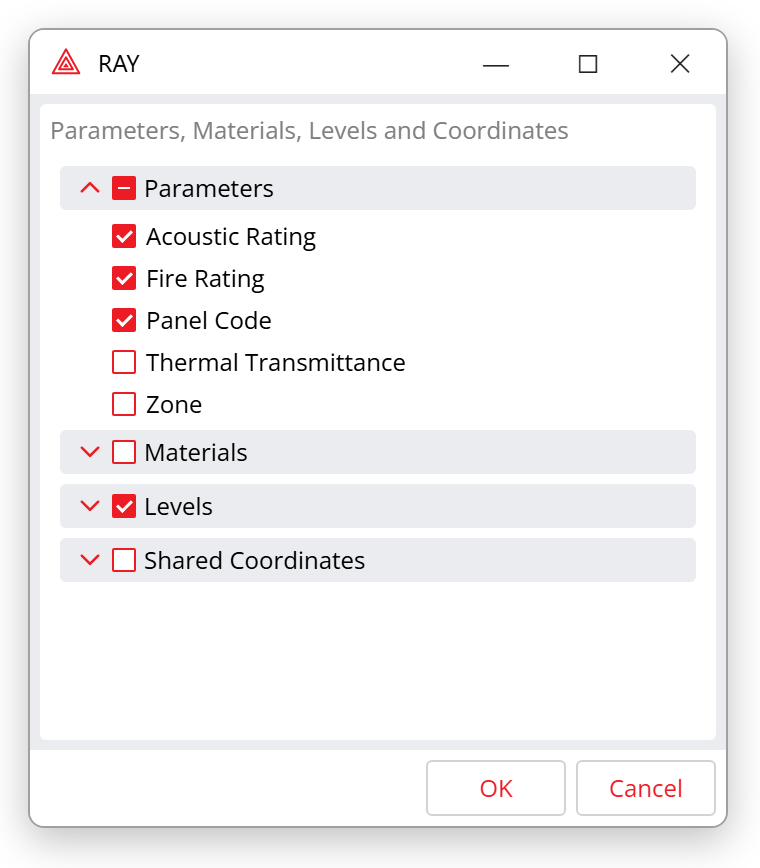
Choose **Parameters, Materials, Levels and Coordinates** and click **BEAM**. Tick what you want to export.
| Group | Contains |
| ---------------------- | ---------------------------------------------------------------- |
| **Parameters** | Project and shared parameters, with their type and categories |
| **Materials** | Material names and colours |
| **Levels** | Level names and elevations |
| **Shared Coordinates** | The active location: E/W, N/S, elevation and angle to true north |
Click **OK**, then name the file. RAY saves a `.bin` file. In Rhino, [RAY](/beam/beam-for-rhinoceros/ray.md#import-properties) creates the parameters, materials and levels, and the location as a named CPlane.
## Pages in this section
{% content-ref url="/pages/OEXIllwhqXk4EjG8CHoR" %}
[Batch Export](/beam/beam-for-revit/ray/batch-export.md)
{% endcontent-ref %}
{% content-ref url="/pages/nipVYitAoKYuA2rkcnAr" %}
[Layer Mapping](/beam/beam-for-revit/ray/layer-mapping.md)
{% endcontent-ref %}